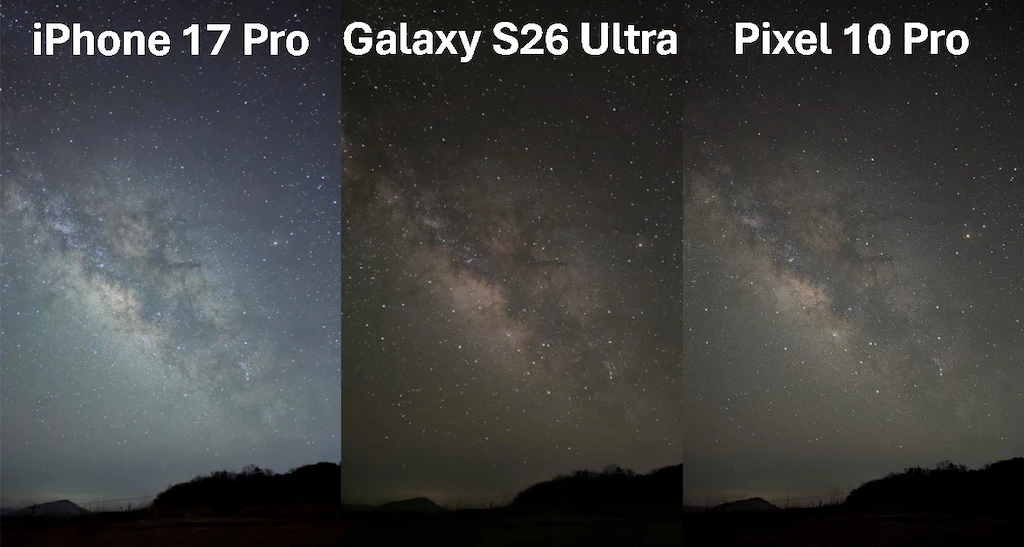
The iPhone 18 Pro introduces a variable aperture, giving you more control over how you shoot the night sky.
But more options also make things more complicated. Does ProRAW really give you better image quality? Which aperture works best for astrophotography? And how much better is the iPhone 18 Pro than the iPhone 17 series?
To find out, I tested different file formats and apertures on the iPhone 18 Pro. I also compared it directly with the iPhone 17 Pro and iPhone 17.
The result was surprising. The iPhone 18 Pro gives you more shooting flexibility, but in these tests I could not find a clear image-quality advantage over the iPhone 17 series.
That said, f/1.48 produced the brightest straight-out-of-camera image and made the Milky Way stand out the most.
1. Test Conditions
I tested three models:
・iPhone 18 Pro
・iPhone 17 Pro
・iPhone 17
All three were running iOS 27.
To keep the conditions as similar as possible, I mounted each phone on the same tripod and photographed the same area of the night sky at almost the same time.
All images were taken with a 30-second Night mode exposure.
I mainly compared:
・faint-star visibility
・noise
・overall brightness
・star shape
・halos and smearing around stars
2. JPEG vs HEIF vs ProRAW
First, let’s look at file formats.
The iPhone can save photos as JPEG, HEIF, or ProRAW. ProRAW is often recommended for astrophotography because it gives you more editing flexibility.
But does ProRAW actually produce a better final image?
I took the same night-sky scene with the iPhone 18 Pro at f/1.48.
iPhone 18 Pro: JPEG / HEIF / ProRAW
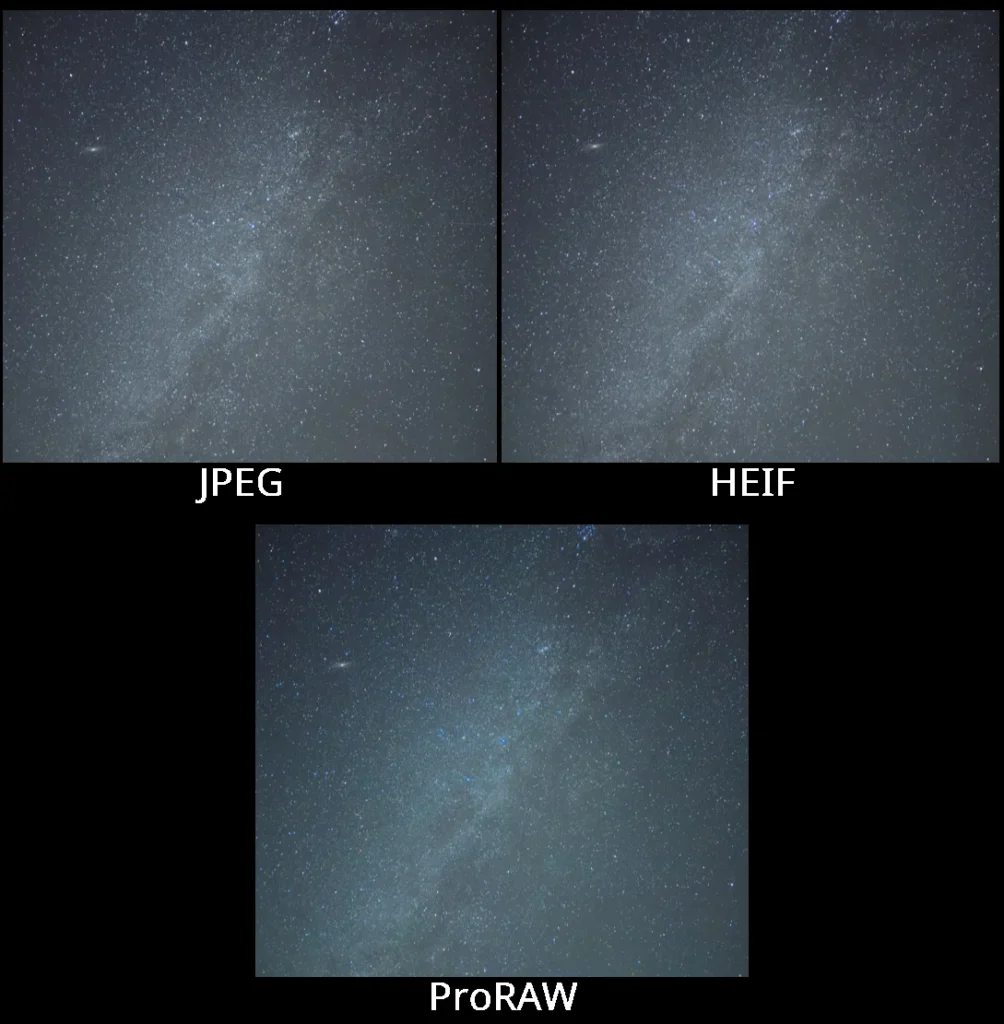
For the ProRAW version, I opened the DNG file in Lightroom and exported it directly to JPEG without making any manual adjustments.
At normal viewing size, I can see almost no meaningful difference between JPEG and HEIF.
ProRAW, however, looks noticeably different. The overall image has a stronger blue/cyan cast.
Let’s zoom in.
JPEG / HEIF / ProRAW — Cropped Comparison
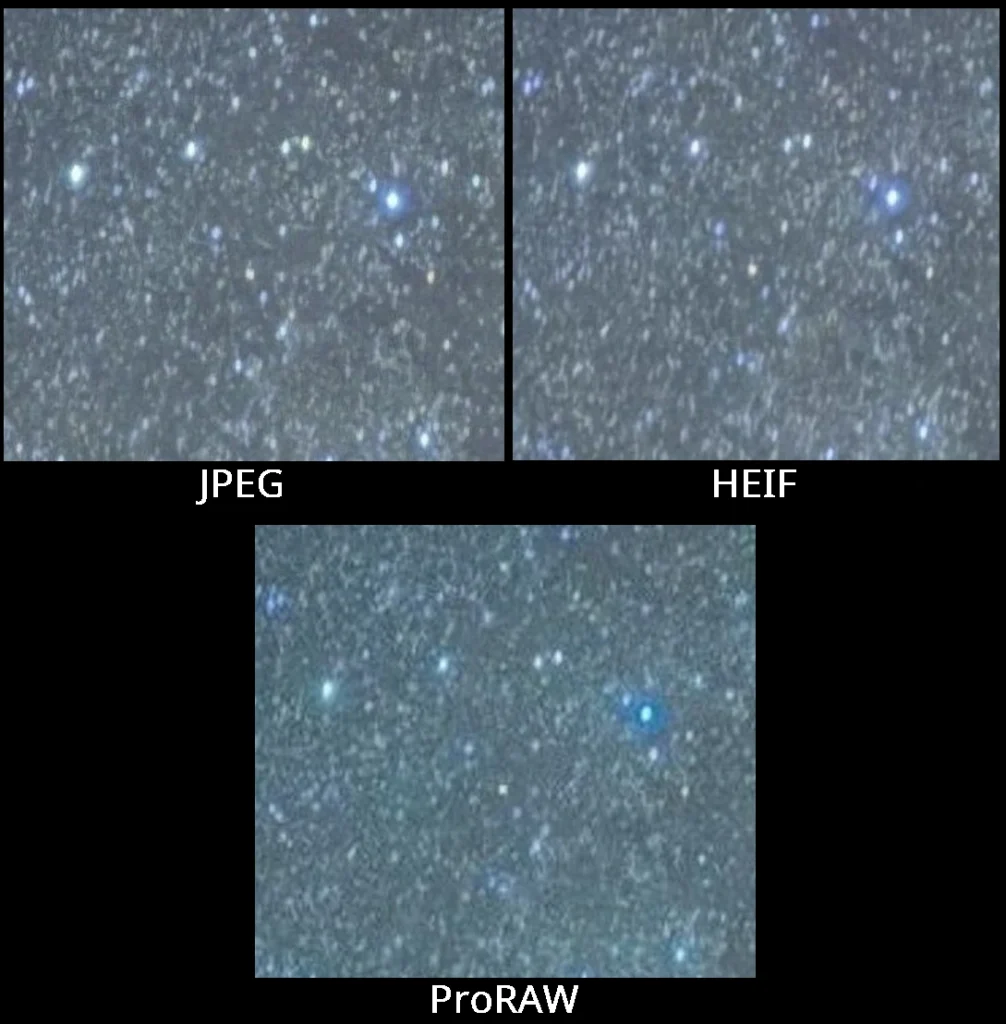
Again, JPEG and HEIF look almost identical.
The ProRAW image is different. Bright stars have a much more noticeable blue halo or blue smearing around them.
There is also more color noise in the background, and I do not see a clear advantage in the number of visible stars or fine detail.
JPEG and HEIF benefit from the iPhone’s built-in image processing, including color correction and noise reduction. For this type of night-sky photography, that processing appears to work very well.
The blue halos seen in the ProRAW image are also not something that can be easily removed with a simple Lightroom adjustment.
This is an important point:
ProRAW does not automatically mean better image quality.
ProRAW is better thought of as a file format that gives you more data and more freedom for editing. It is not a “maximum image quality” mode that will always produce a better finished photo.
In this test, I could not find a clear image-quality advantage from shooting ProRAW. In fact, JPEG and HEIF produced more polished images straight out of the camera, with better-looking star colors, less noise, and less color smearing.
For that reason, I use JPEG for the rest of this comparison.
3. You Don’t Need to Worry About 12MP vs 24MP
The iPhone 18 Pro lets you choose between output resolutions such as 12MP and 24MP.
However, in my astrophotography tests, the final Night mode images were saved at 12MP regardless of the resolution setting.
So for this type of 30-second Night mode astrophotography, the resolution setting does not appear to be important.
I therefore did not include a separate resolution comparison.
4. Which Aperture Is Best?
One of the biggest changes on the iPhone 18 Pro is the ability to change the aperture.
I compared f/1.48, f/1.8, f/2.8, and f/4.
Aperture Comparison
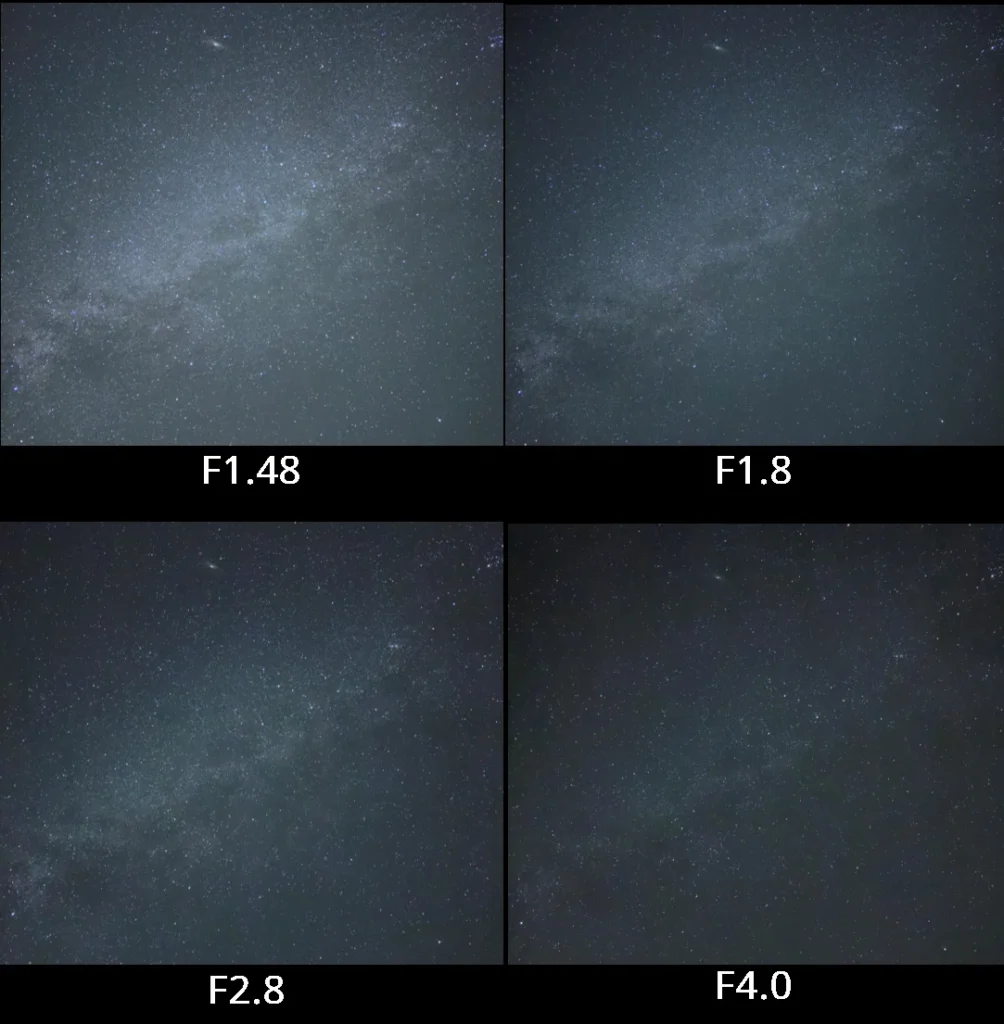
The difference in overall brightness is immediately visible.
f/1.48 produces the brightest image. As the aperture becomes smaller, the entire image becomes darker because less light reaches the sensor.
Now let’s look more closely.
Aperture Comparison — Cropped
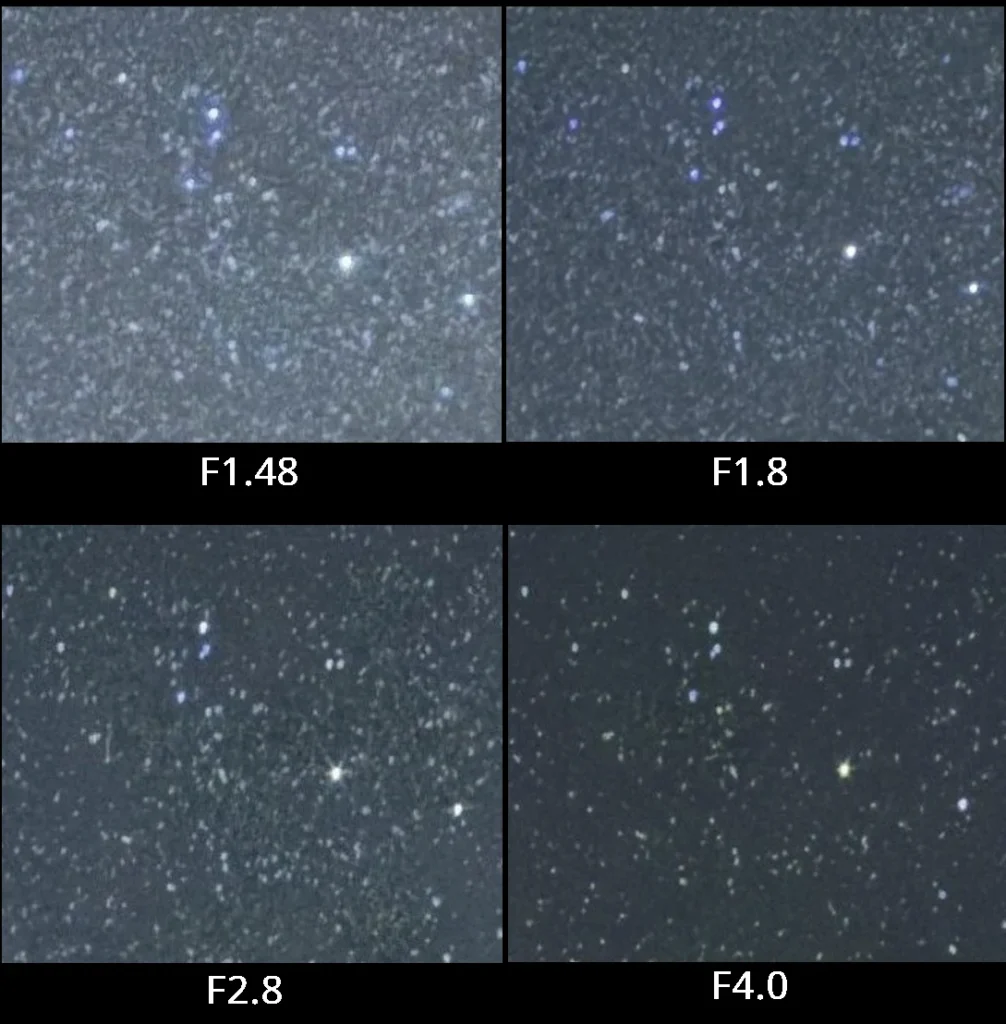
At f/1.48, the image is the brightest and captures many faint stars. However, bright stars show more noticeable halos, and the background also looks noisier.
At f/1.8, the sky is darker than at f/1.48, but the number of visible stars is still very similar. The stars look smaller and more circular, with less glow around them. Background noise is also better controlled, so the overall image looks more polished.
At f/2.8 and f/4.0, the halos around bright stars become less noticeable, but the loss of faint stars becomes more significant.
So, in this test, two aperture settings stand out depending on what you want.
Choose f/1.48 if you want maximum brightness, more faint detail, and the strongest straight-out-of-camera impact.
Choose f/1.8 if you care more about cleaner star shapes, less haloing, lower noise, and a more balanced final image.
Neither setting is clearly better in every situation. They simply have different strengths.
For the comparison with the iPhone 17 series, I therefore use both f/1.48 and f/1.8 as representative settings for the iPhone 18 Pro.
5. Is the iPhone 18 Pro Actually Better Than the iPhone 17 Series for Astrophotography?
This is the main comparison.
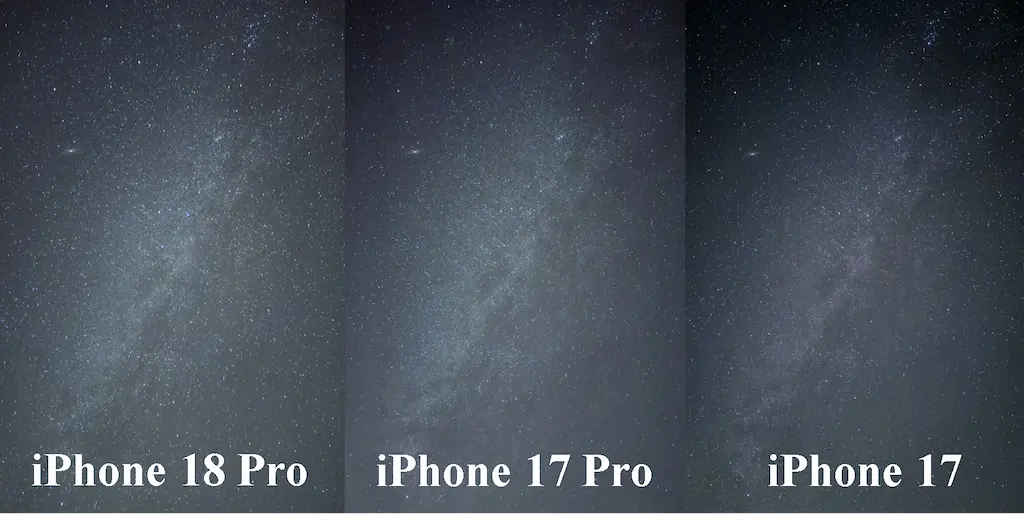
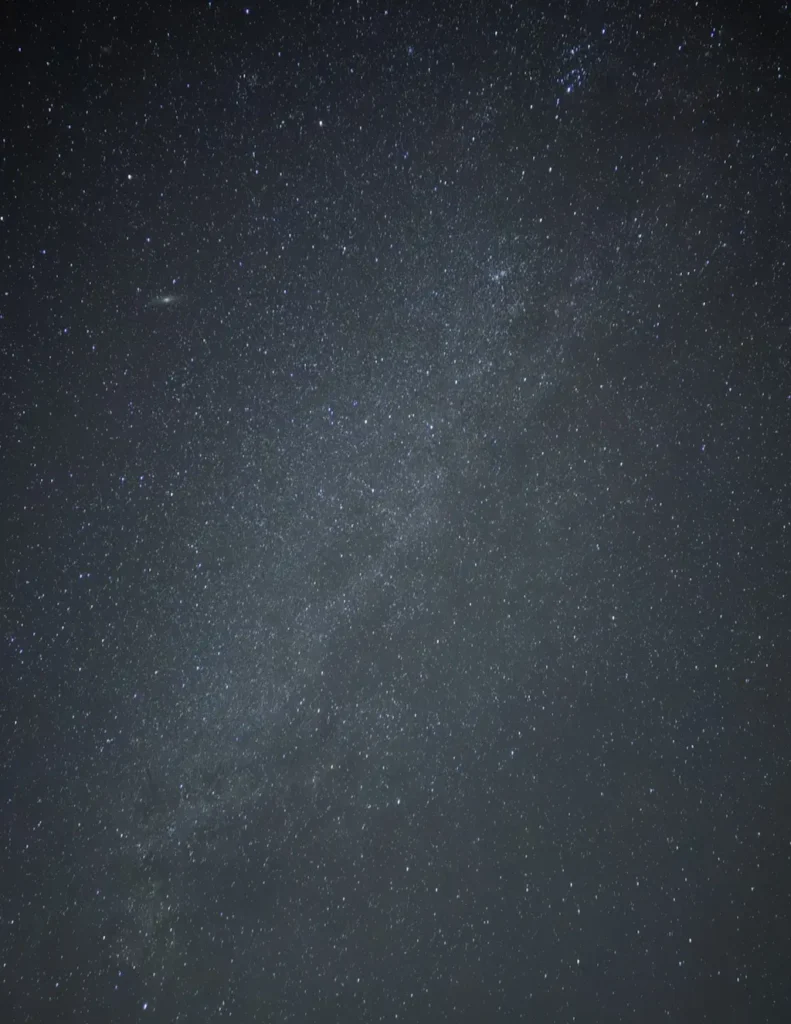
iPhone 18 Pro — f/1.48
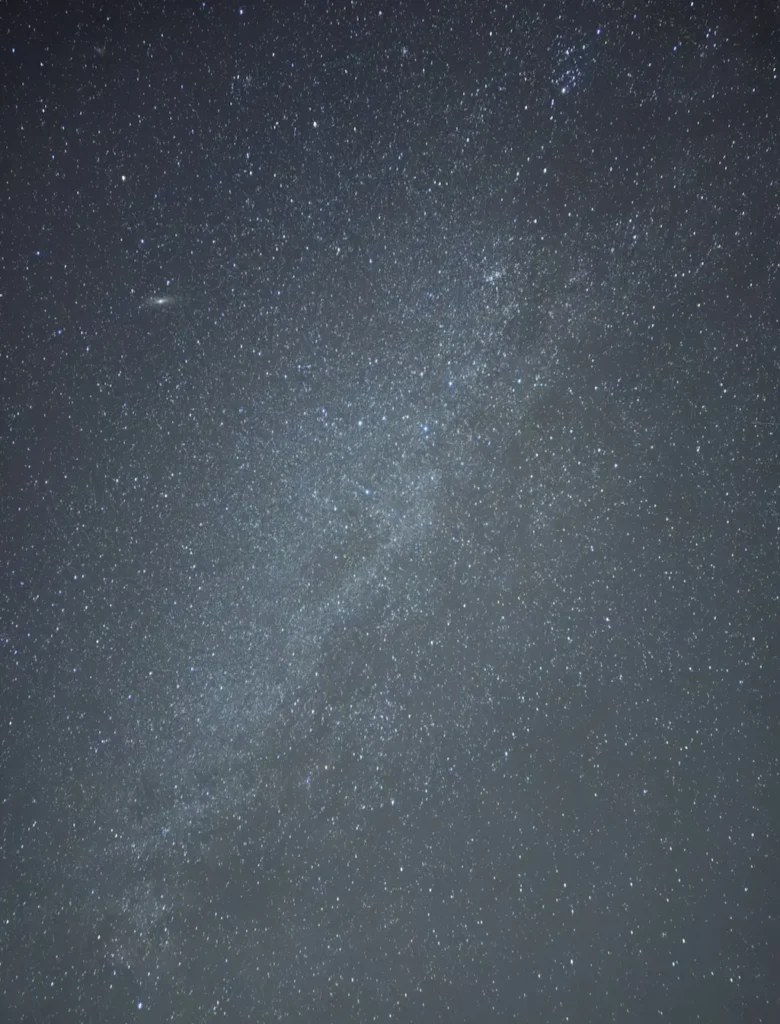
iPhone 17 Pro
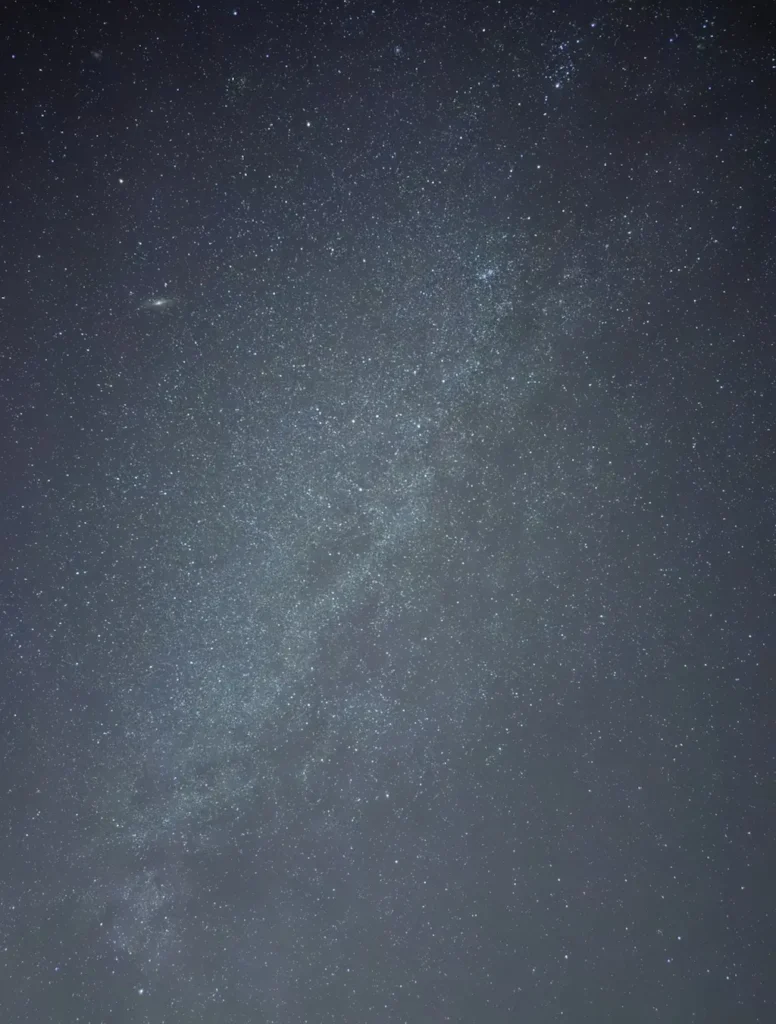
iPhone 18 Pro — f/1.8
iPhone 17
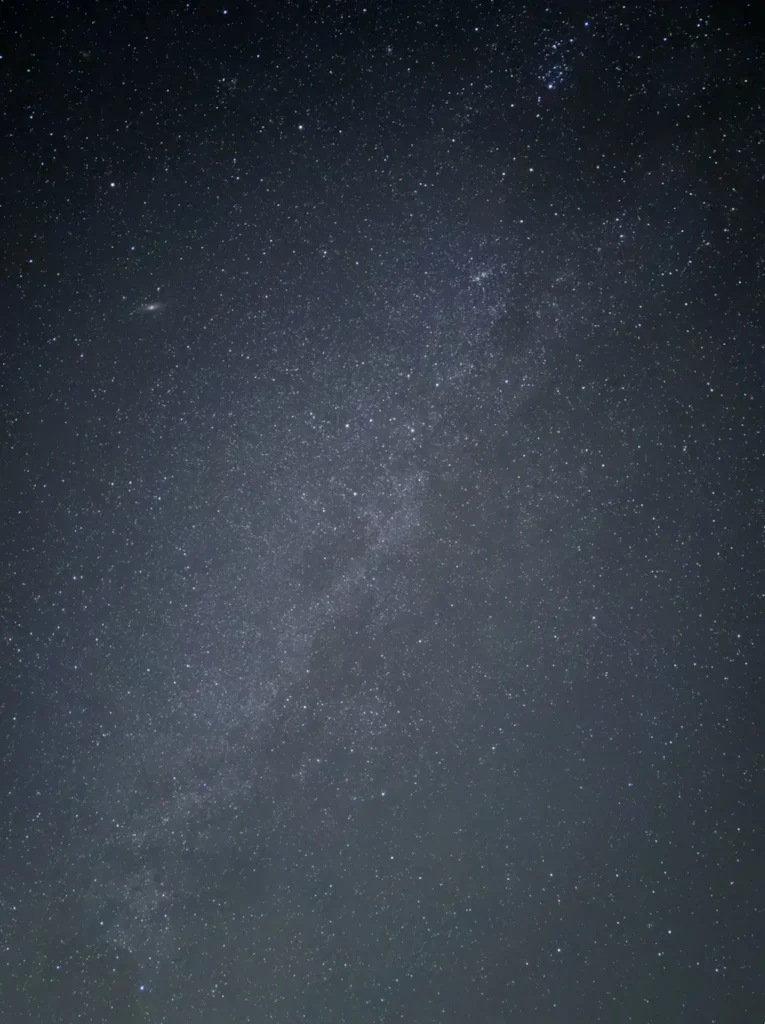
The iPhone 18 Pro f/1.48 produces the brightest and most eye-catching image overall.
Looking at the general brightness, these two pairs appear to be the closest:
iPhone 18 Pro f/1.48 ≈ iPhone 17 Pro
iPhone 18 Pro f/1.8 ≈ iPhone 17
So let’s compare those pairs more closely.
iPhone 18 Pro f/1.48 vs iPhone 17 Pro
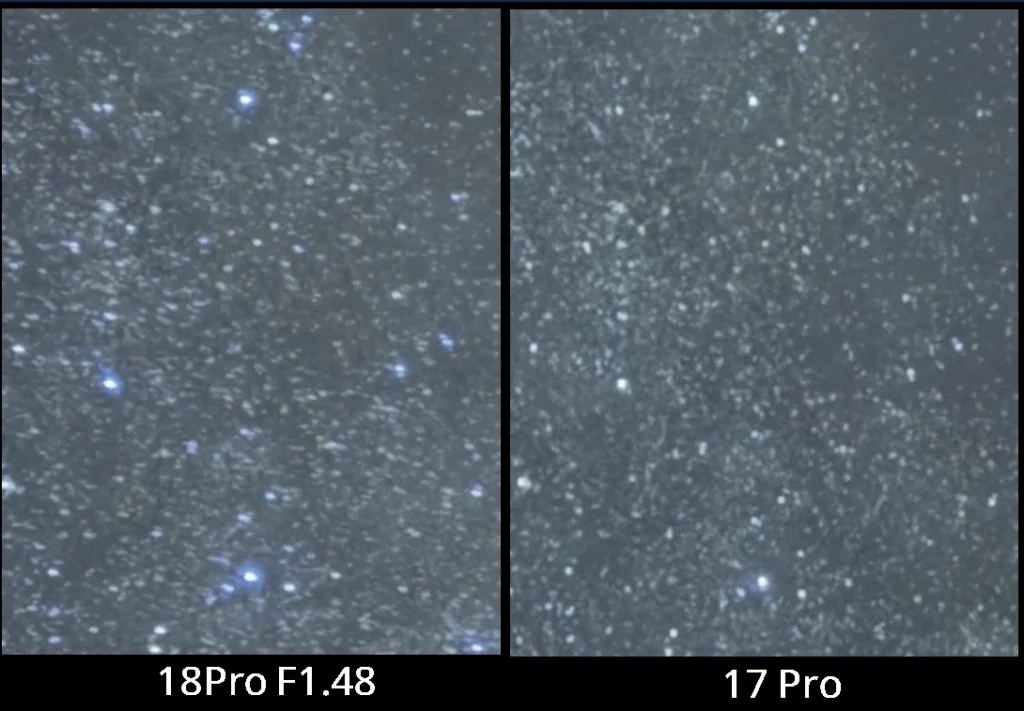
At f/1.48, the iPhone 18 Pro shows noticeable blue smearing around bright stars. On the iPhone 17 Pro, this blue halo is much less visible, and the stars are more clearly separated from the dark background.
The number of visible stars is also very similar, so it is difficult to find a clear area where the iPhone 17 Pro is significantly worse.
The iPhone 18 Pro at f/1.48 produces a brighter image straight out of the camera, but when star halos and overall image quality are taken into account, I think the iPhone 17 Pro looks more refined.
iPhone 18 Pro f/1.8 vs iPhone 17
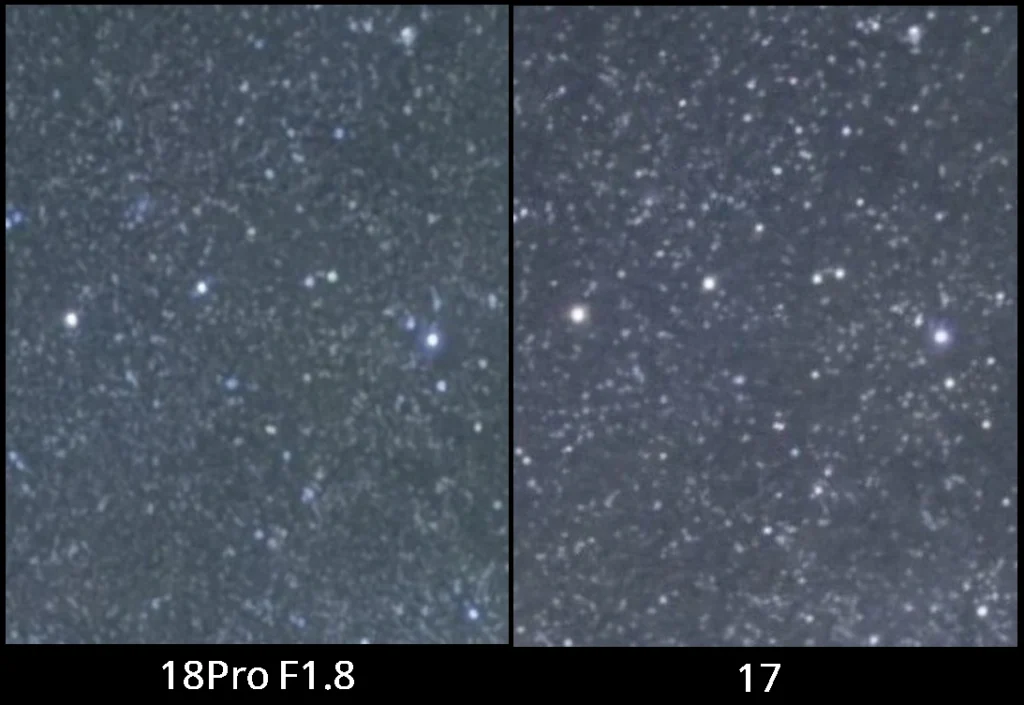
Using f/1.8 on the iPhone 18 Pro reduces the smearing around stars quite a lot. Even so, the iPhone 17 shows less blue haloing, and individual stars look sharper and more clearly defined.
The color of the night sky also looks more natural on the iPhone 17, with less visible background noise.
When you zoom in, the iPhone 17 stands out for its overall image quality and looks more polished than the iPhone 18 Pro at f/1.8.
6. Is the New Variable-Aperture System Still Maturing?
iPhone astrophotography has become more refined with each generation. The iPhone 17 series, in particular, seems to have reached a very high level of polish through the combination of a fixed-aperture lens and Apple’s image processing.
The iPhone 18 Pro introduces a major change: a faster f/1.48 lens with a variable aperture. Because the optical system has changed so much, the lens itself is one possible reason for the differences we are seeing.
When the iPhone 18 Pro is stopped down from f/1.48 to f/1.8, the halos around stars are clearly reduced. Even so, the iPhone 17 still shows less blue fringing around stars. This suggests that part of the difference may come from the camera hardware itself.
However, software is also important.
On the same iPhone 18 Pro, JPEG and HEIF show much less blue fringing than ProRAW files developed in Lightroom. This suggests that the iPhone’s JPEG/HEIF processing is correcting at least some of the color fringing.
Even with that processing, though, the iPhone 18 Pro still does not match the cleaner star rendering of the iPhone 17 in these tests. This may mean that Apple’s image processing is not yet fully optimized for the new larger-aperture, variable-aperture system.
It is not possible to identify a single cause from these tests alone. The lens, sensor, and image processing may all play a role. Still, for astrophotography, the iPhone 18 Pro’s new camera system looks less mature than the well-refined combination of optics and processing found in the iPhone 17 series.
If part of the difference comes from software, future iOS updates may improve star halos, color fringing, and noise. But if some of it comes from the optical design itself, software may not be able to remove it completely.
Conclusion
You don’t need to choose ProRAW just because you are shooting the night sky. In this comparison, I found no clear image-quality advantage over JPEG or HEIF. In fact, JPEG and HEIF were easier to work with and generally produced more polished results.
The iPhone 18 Pro now lets you change the aperture, giving you more flexibility for astrophotography. In my testing, f/1.48 and f/1.8 were the most useful settings for shooting the stars.
However, with the main camera, neither f/1.48 nor f/1.8 showed a clear image-quality advantage over the iPhone 17 series. That said, f/1.48 does have one clear strength: it produces a brighter and more impressive night-sky image straight out of the camera.