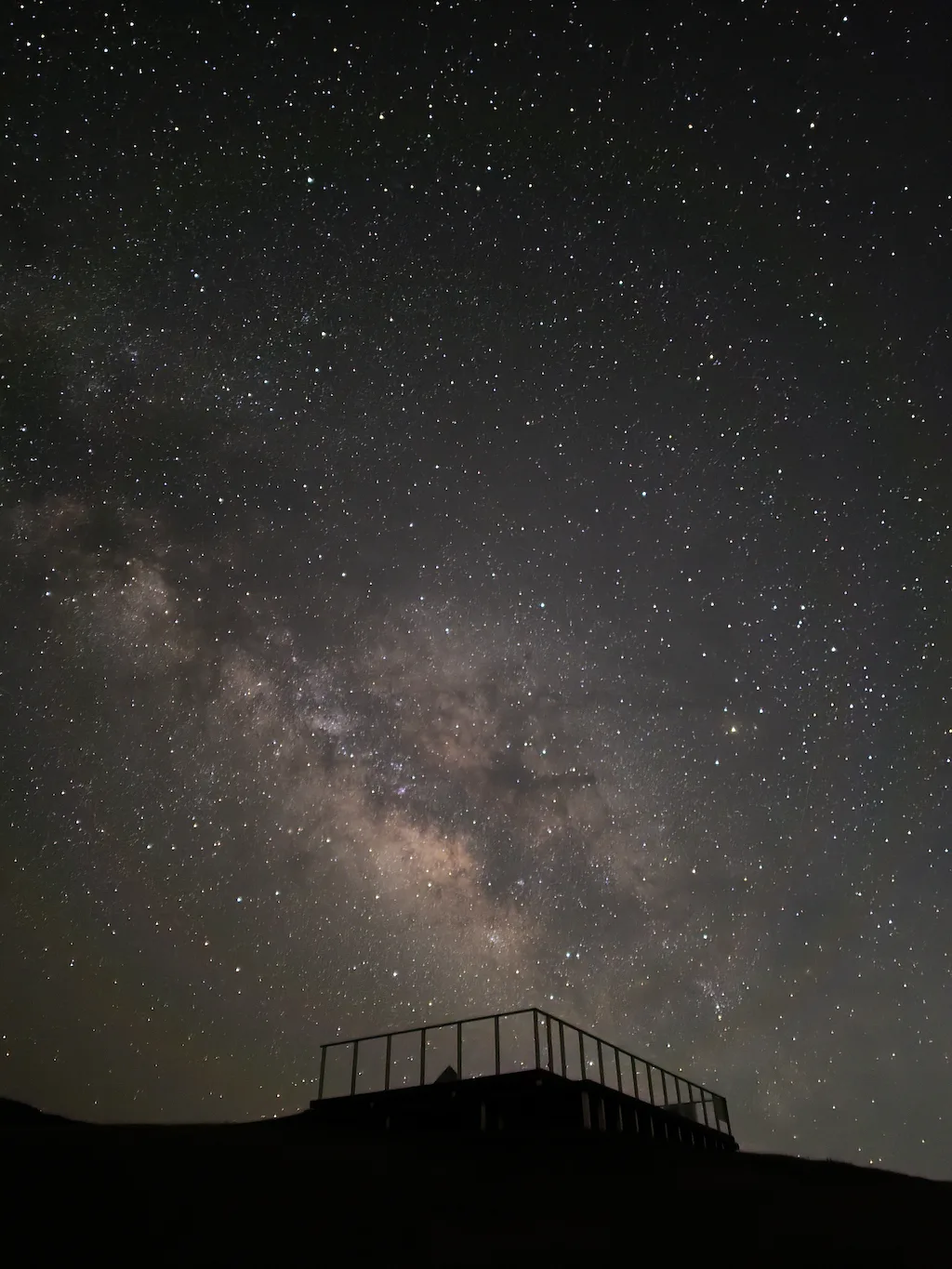
Samsung says the Galaxy S26 Ultra features its brightest camera system yet. With low-light performance expected to be one of its biggest upgrades, we tested that claim in one of the toughest shooting conditions possible: astrophotography.
In this comparison, we looked at how the Galaxy S26 Ultra performs against the Galaxy S25 Ultra when shooting the night sky, and how much of an improvement it really delivers.
1. Key takeaway
What Samsung means by “the brightest camera” is that the main wide camera has been upgraded from f/1.7 on the S25 Ultra to f/1.4 on the S26 Ultra.
For this test, we compared the wide cameras on both phones using Pro mode and Expert RAW.
Our conclusion is that the Galaxy S26 Ultra does show a real improvement in astrophotography. The upgrade starts with the hardware: the move from f/1.7 to f/1.4 allows the camera to capture more light. On top of that, improvements in Expert RAW appear to make better use of that extra image data. Together, these changes result in clearly better night-sky performance.
For the actual shooting workflow, settings, and no-tripod tips, check the Galaxy astrophotography guide.
Samsung Galaxy Astrophotography Guide(Expert RAW + Pro Mode)
2. What Pro mode reveals about the hardware upgrade
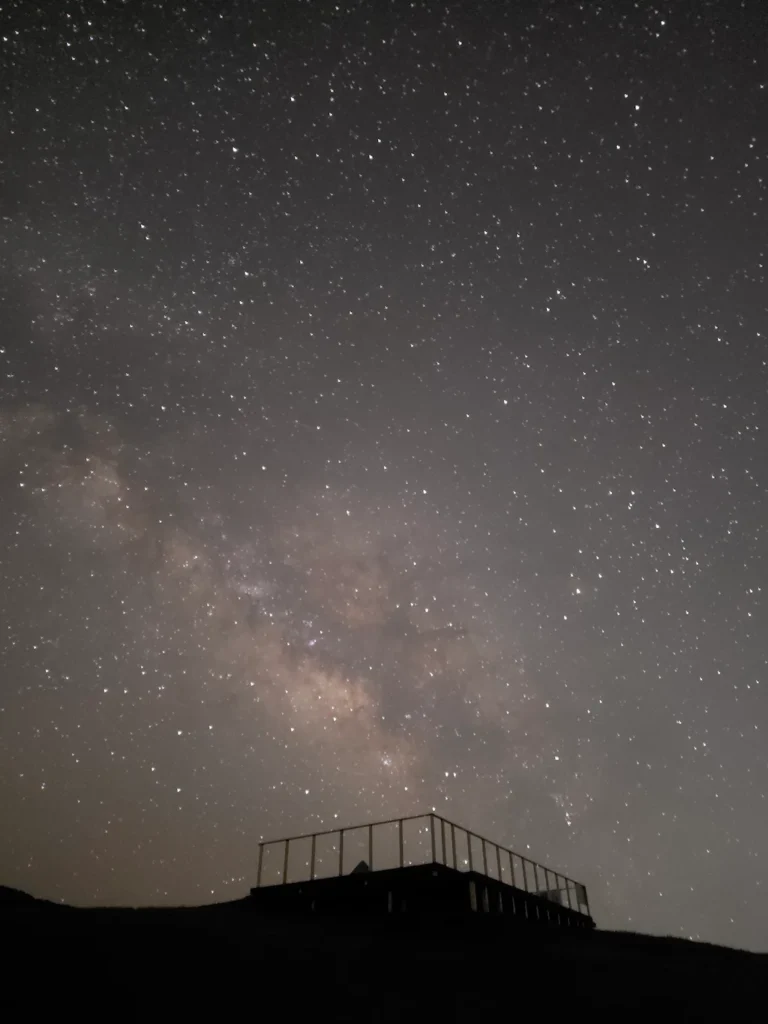
We first compared the two phones using Galaxy’s Pro mode. The shutter speed was fixed at 30 seconds on both devices, and we tested multiple ISO settings. Here, we are using ISO 1600 as a representative example.
S26 Ultra
S25 Ultra
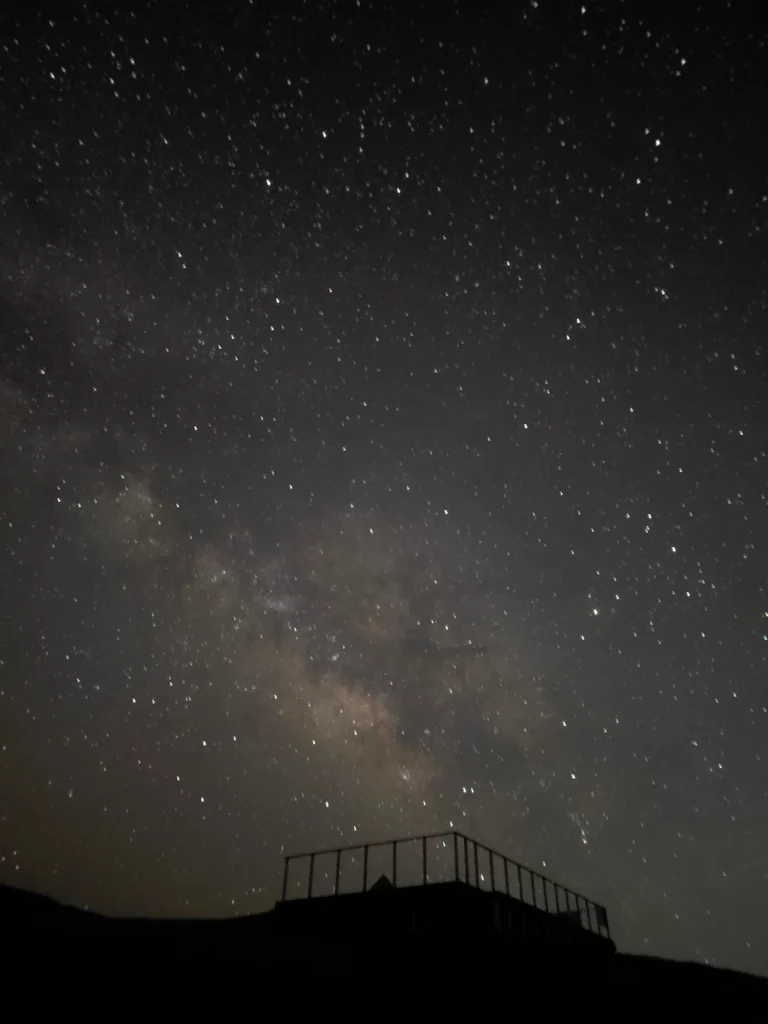
Looking at the image data, the S26 Ultra was shot at f/1.4, while the S25 Ultra was shot at f/1.7. At the same ISO, the S26 Ultra produced a brighter overall image, and this pattern was consistent across other ISO settings as well.
This suggests that the S26 Ultra’s brighter lens is allowing it to gather more light under the same conditions. In other words, the first stage of the improvement in astrophotography comes from the hardware itself: increased light intake.
Next, we compared cropped portions of the Pro mode images.
Crop comparison
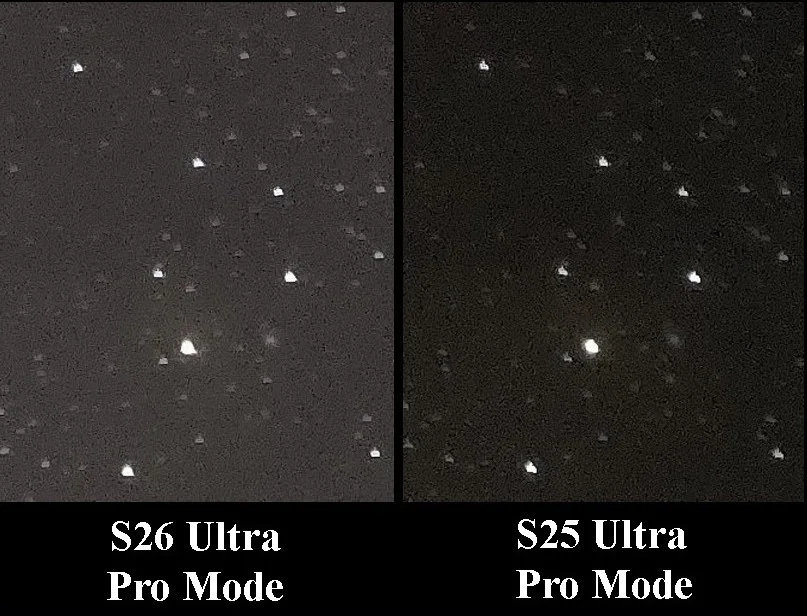
When zoomed in, the number of visible stars was almost the same on both phones. This shows that while the S26 Ultra clearly improves overall brightness and light capture in Pro mode, that hardware gain alone does not lead to a major increase in the number of stars recorded.
3. The difference becomes clearer in Expert RAW
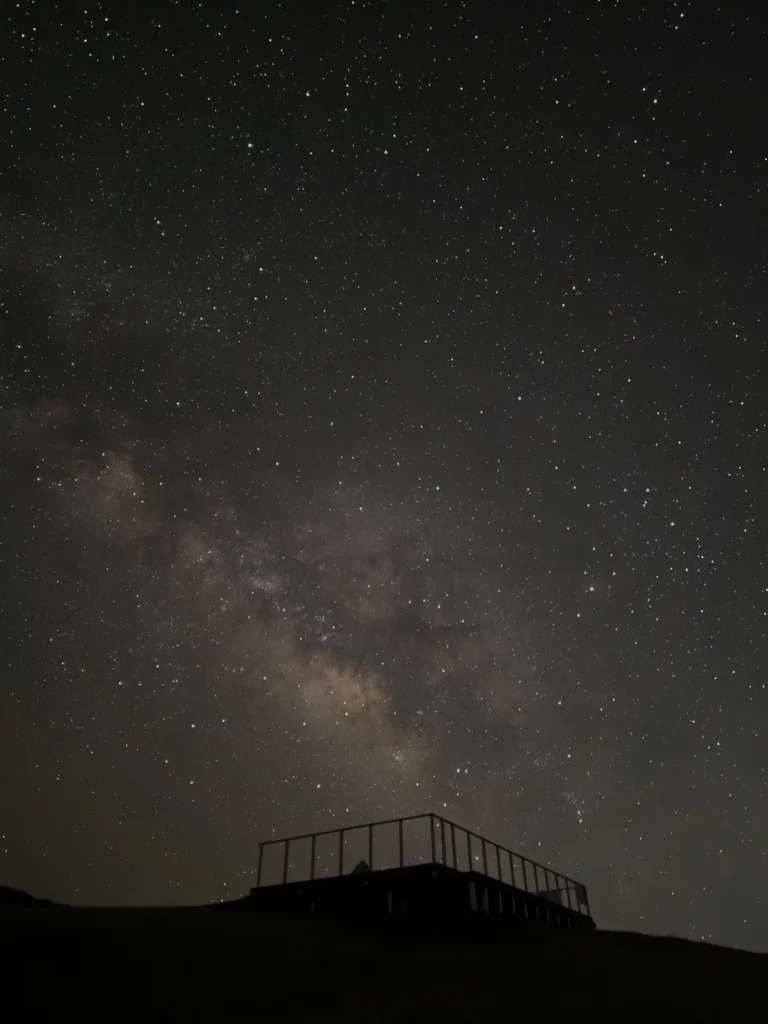
We then compared image quality in Expert RAW, with both phones set to Short capture time. While Expert RAW allows some basic editing after the shot, the images compared here are completely unedited.
S26 Ultra
S25 Ultra
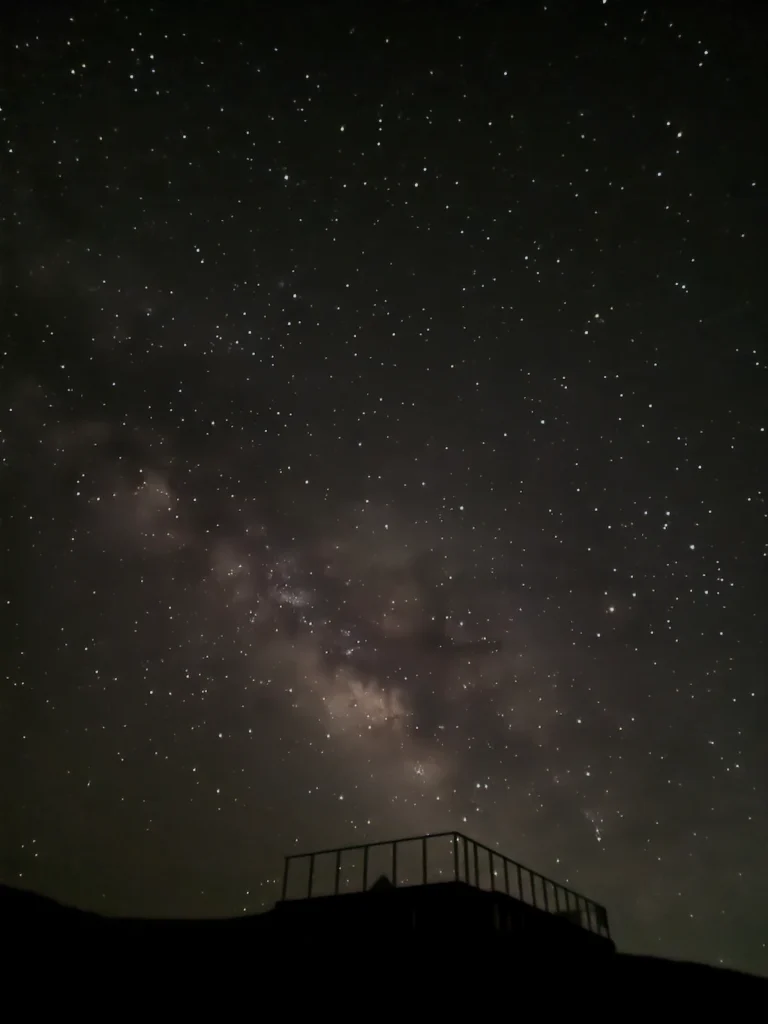
Compared side by side in Expert RAW, the S26 Ultra shows clearer Milky Way detail and appears to capture more stars overall. The final image also gives a stronger impression of pulling more information out of the night sky.
We also compared cropped sections of the images.
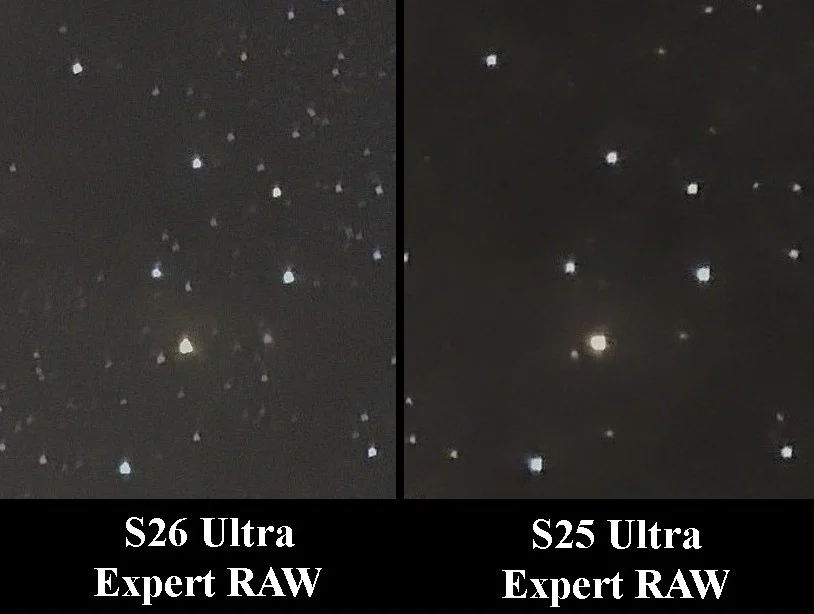
In the crop, the S26 Ultra preserves more stars.
4. Comparing Pro mode and Expert RAW on each phone
To better understand what is happening, we also compared Pro mode and Expert RAW on the same device.
S26 Ultra
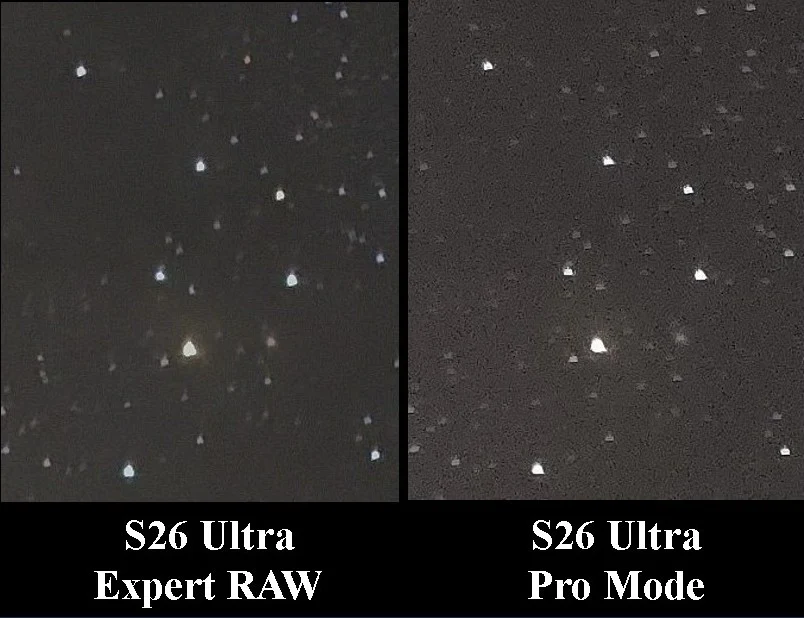
On the S26 Ultra, Expert RAW reduces noise compared to Pro mode, but only slightly reduces the number of visible stars. Most of the stars are still preserved. This suggests that the S26 Ultra is able to balance noise reduction and star retention at a high level.
S25 Ultra
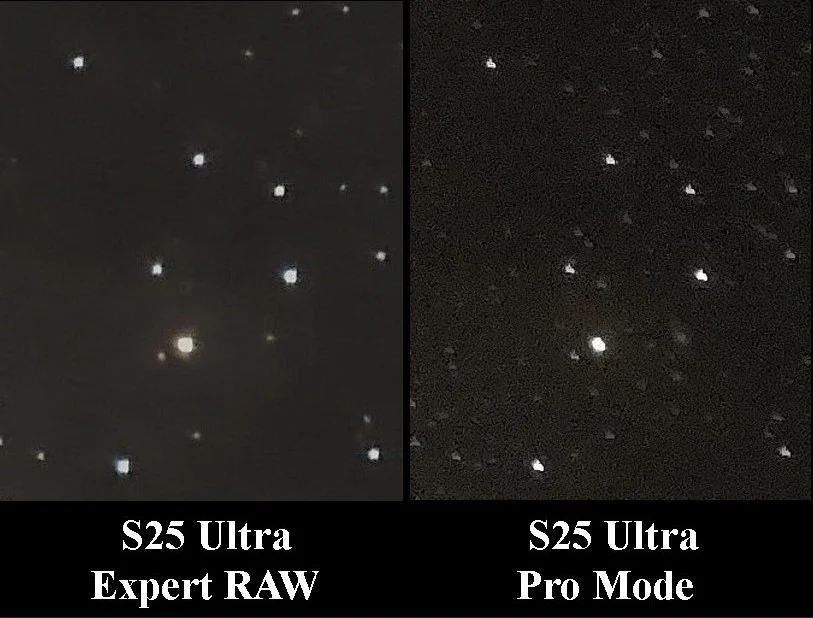
On the S25 Ultra, Expert RAW also reduces noise compared to Pro mode. However, it does so at a much greater cost: the number of visible stars drops significantly. In other words, stars are more likely to disappear as a trade-off for noise reduction.
This comparison suggests that Expert RAW has clearly improved on the S26 Ultra. It does a better job of reducing noise while still keeping more of the stars intact.
5. The biggest real-world benefit: more editing headroom
The biggest advantage of preserving stars while keeping noise under control is greater flexibility in post-processing.
We took an Expert RAW image from the S26 Ultra and adjusted it in Samsung’s Gallery app using the following settings:
(Contrast: +30 Highlights: +25 Whites: +30 Color temperature: -5 Sharpness: +15)
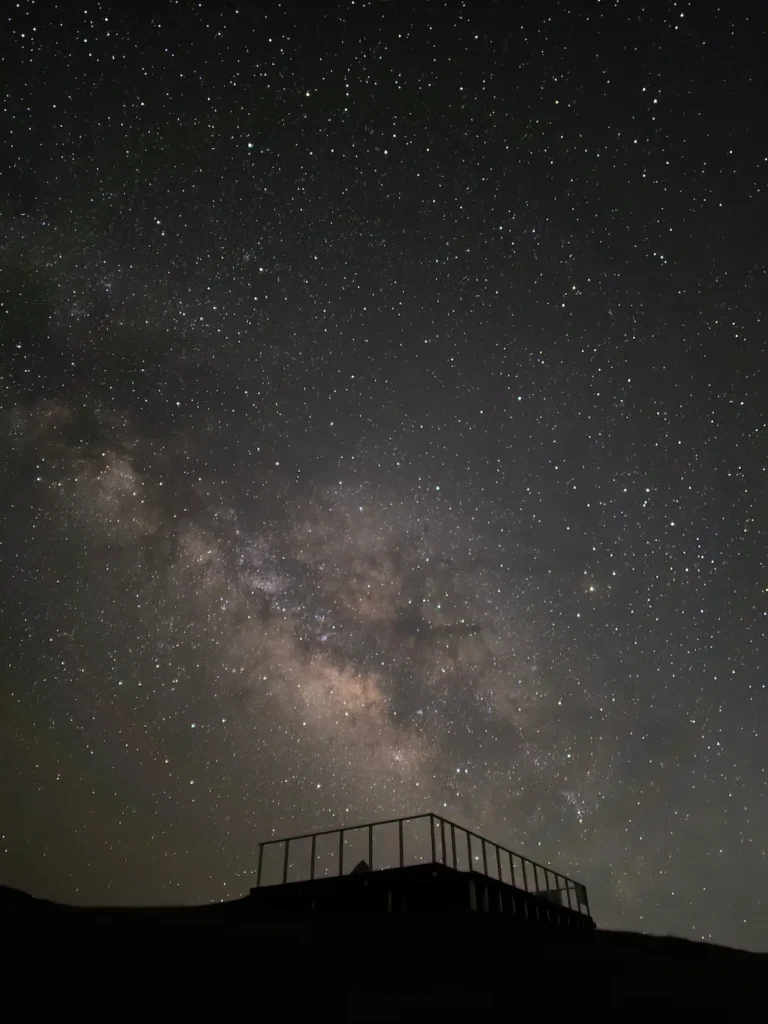
Even with these fairly strong adjustments, noise did not increase dramatically, and the Milky Way and star detail remained well preserved overall.
That is a major benefit of starting with an image that already contains more star detail and cleaner noise handling. It is not just about getting a better straight-out-of-camera result. It also means the S26 Ultra gives you much more room to refine the image creatively afterward.
6. Conclusion
In Pro mode, the S26 Ultra clearly shows the benefit of its f/1.4 aperture, capturing more light than the S25 Ultra under the same conditions. However, the number of stars recorded does not change dramatically in Pro mode alone, which suggests that the improvement seen in Expert RAW cannot be explained by hardware alone.
In Expert RAW, the S26 Ultra is clearly stronger in three areas: star retention, Milky Way detail, and the balance between detail and noise reduction.
In short, the Galaxy S26 Ultra appears to combine two improvements: a brighter f/1.4 lens that gathers more light, and upgraded Expert RAW processing that makes better use of that extra information.