・I tested seven iPhones under the same dark sky: 5× iPhone 17, 1× iPhone 17 Pro, 1× iPhone 16 – all on iOS 26.2.
・In this test, iPhone 17 Pro and iPhone 16 did not miss focus even once on the stars.
・All five iPhone 17 (non-Pro) units showed unstable focus: only about 9–20% of the shots were “perfectly focused” on stars, even on a tripod.
・This strongly suggests a model-level limitation in how iPhone 17 handles point-light sources like stars, rather than a single “bad unit”.
1. What a “good” iPhone 17 frame can look like
[Shot on iPhone 17]

[Shot on iPhone 17 Pro]

At a glance, both images can look similar on a phone screen.
However, with the iPhone 17 (non-Pro), getting one sharp frame often required multiple attempts because many frames were noticeably out of focus on the stars.
This article focuses on focus reliability (how often stars are in focus), not on color differences.
2. The core issue: focus that randomly misses, even on a tripod
[Shot on iPhone 17]
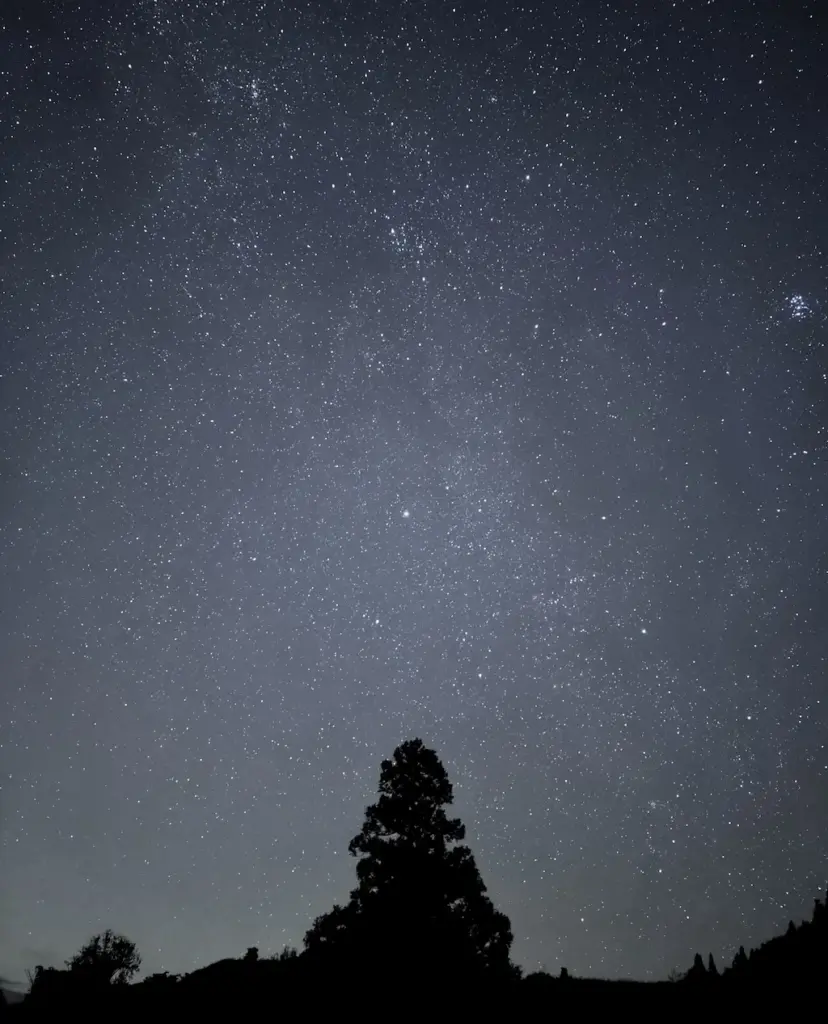
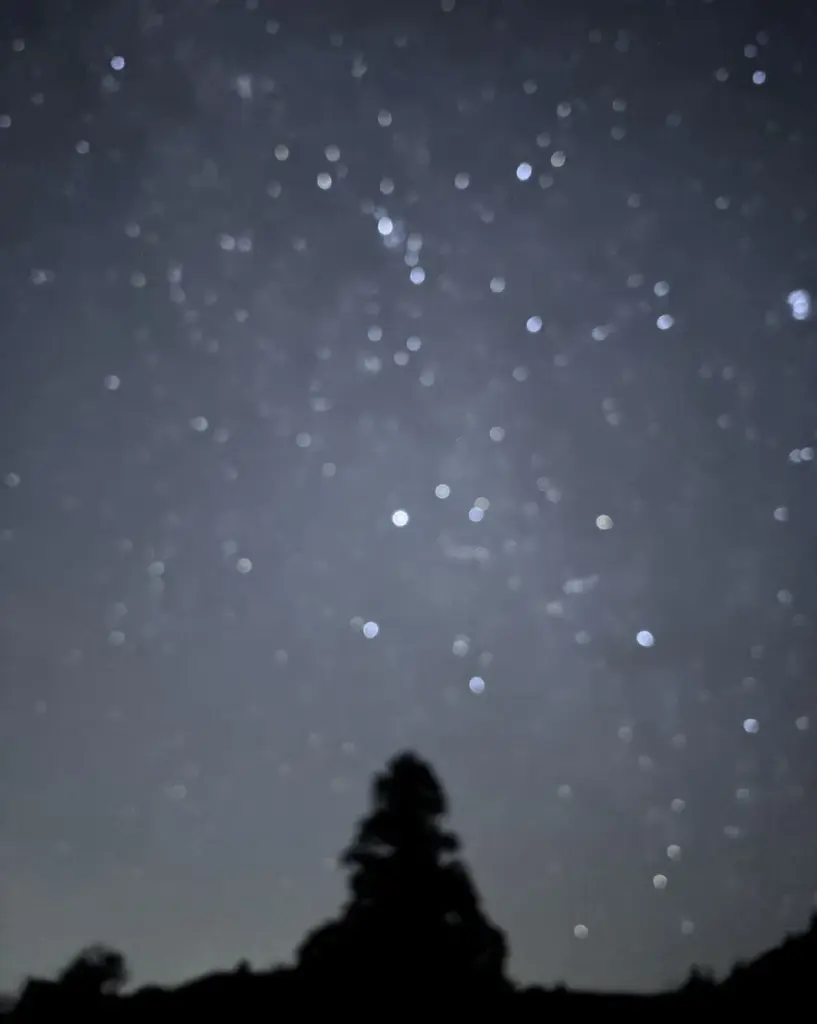
The two frames above were shot with:
・The same iPhone 17 unit
・On a tripod
・With identical settings
・only seconds apart
Even under these conditions, one frame can be in focus while the next frame is clearly out of focus on the stars. This is the behavior discussed in many online user reports. A key question is whether this is unit-to-unit variation or a more general tendency.
3. Test setup: 5× iPhone 17 + 17 Pro + 16 (7 units total)
Devices
For this test, I prepared five brand-new retail iPhone 17 (non-Pro) units. All were Black, and I intentionally mixed storage options and purchase timing.
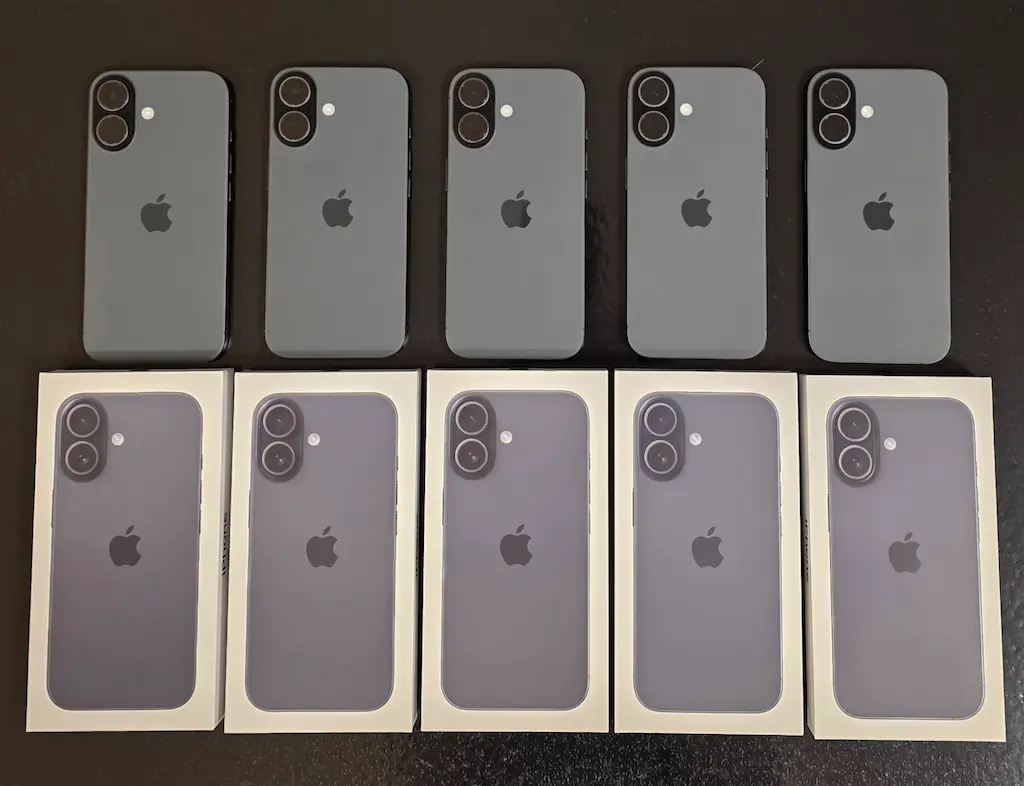
・iPhone 17 A – 256 GB, bought on Amazon Japan (Dec 2025)
・iPhone 17 B – 256 GB, bought from Apple Online Store (Dec 2025)
・iPhone 17 C – 512 GB, bought from Apple Online Store (Dec 2025)
・iPhone 17 D – 512 GB, bought from Apple Online Store (Dec 2025)
・iPhone 17 E – 256 GB, bought from Apple Online Store at launch (Sep 2025, early batch)
To have a reference:
・iPhone 17 Pro – 1 unit
・iPhone 16 (non-Pro) – 1 unit
All devices ran iOS 26.2.
Shooting conditions
・Location: a dark rural mountain area in Shikoku, Japan
・All phones mounted on tripods.
・Pointed in almost the same direction toward a dark star field.
(no specific constellation – the goal was simply “do the stars come into focus or not?”)
・ I repeatedly pressed the shutter on each device and then classified every frame.
Classification (how each frame was judged)
Each frame was classified into one of three categories:
・Match – Stars are sharp and well-defined, with no noticeable softness or smearing.
・Acceptable – Slightly soft, but usable in practice on a phone screen
・Out of focus – Stars are clearly smeared/blurred; the shot is a miss for astrophotography
For step-by-step instructions (Night mode settings, exposure tips, etc.), see this guide: → iPhone Astrophotography(iOS 26): No Tripod Needed
4. Results: numbers, not just impressions
Per-device results (number of frames)
| Device | Match | Acceptable | Out of focus | Total |
| iPhone 16 | 78 | 0 | 0 | 78 |
| iPhone 17 Pro | 79 | 0 | 0 | 79 |
| iPhone 17 A | 13 | 11 | 57 | 81 |
| iPhone 17 B | 15 | 11 | 48 | 74 |
| iPhone 17 C | 13 | 12 | 53 | 78 |
| iPhone 17 D | 11 | 7 | 62 | 80 |
| iPhone 17 E | 7 | 3 | 67 | 77 |
The slight differences in total shots come from throwing out obvious human errors (accidental shake, mis-tap, etc.) that aren’t related to autofocus behavior.
Here is an example frame from the test:
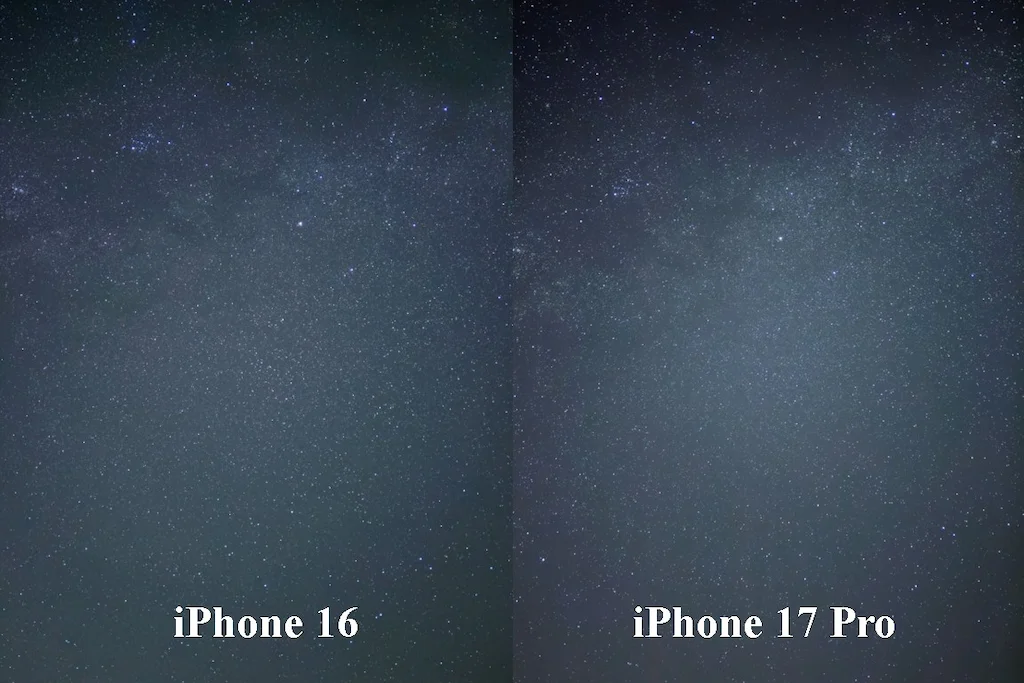
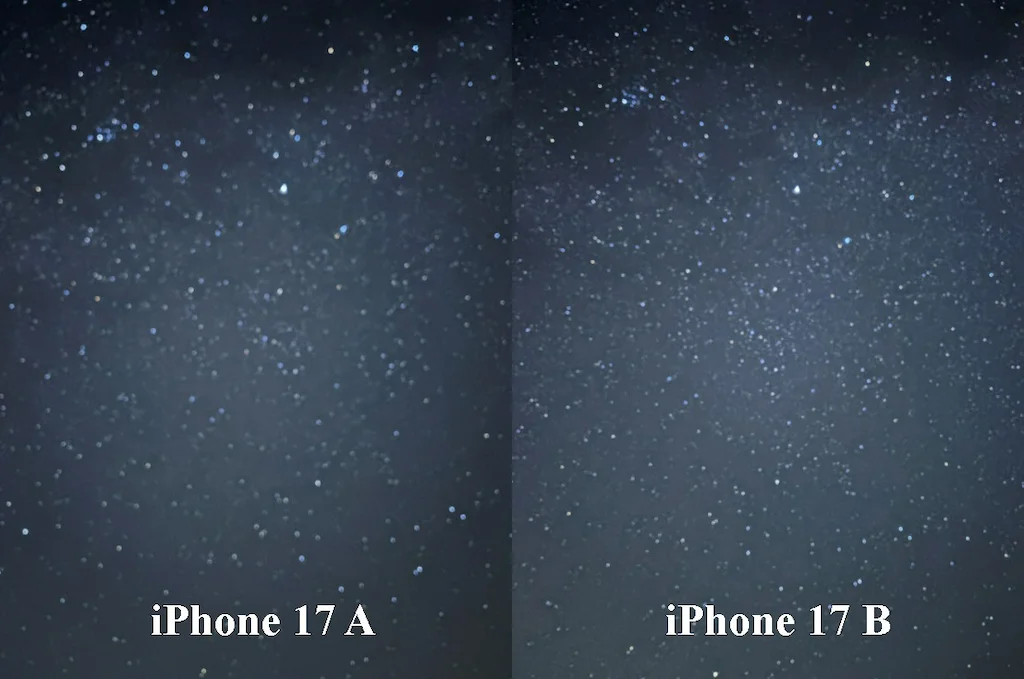
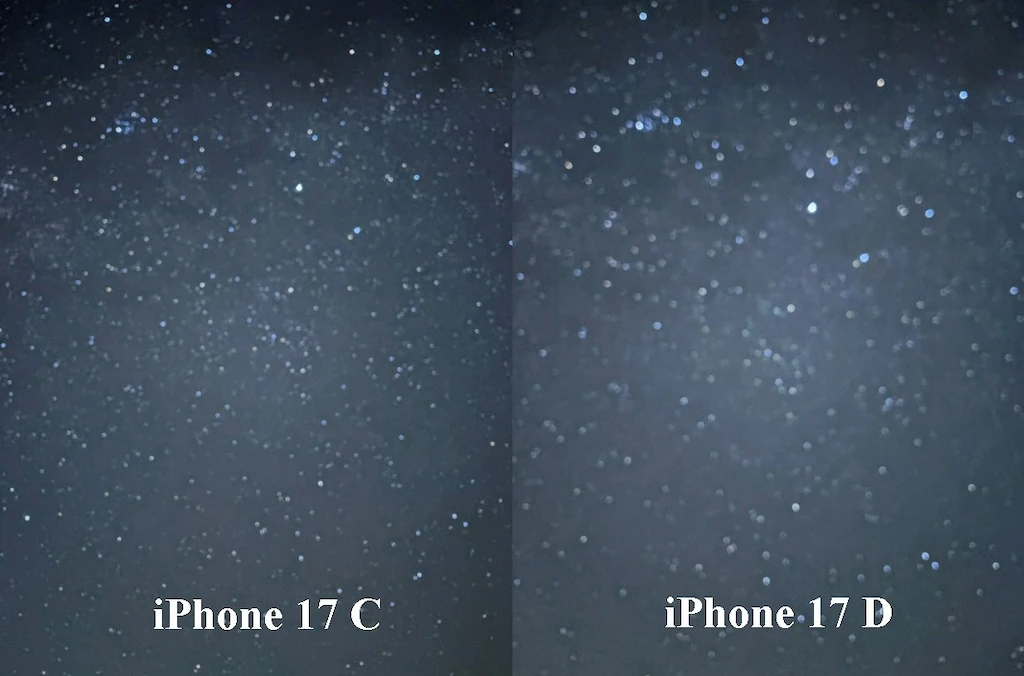
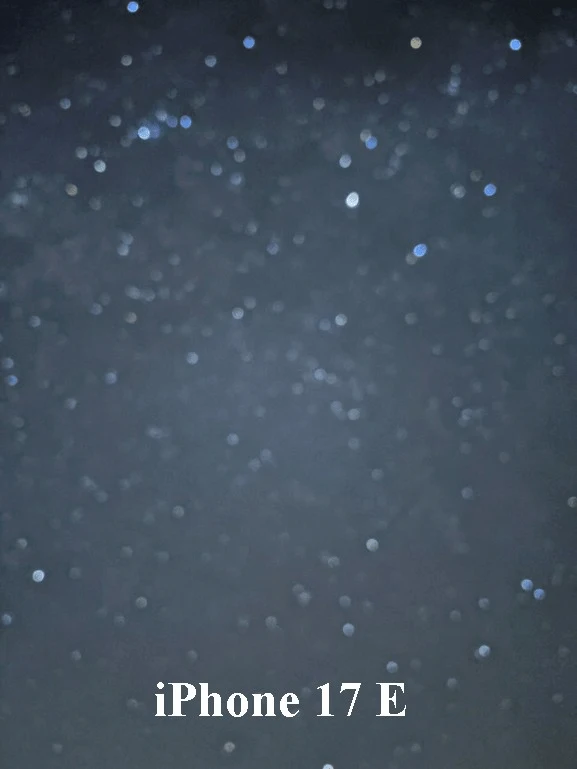
In this example, I classified each phone as follows:
◎ (perfect focus): iPhone 16, iPhone 17 Pro
△ (acceptable): iPhone 17 B
× (out of focus): the remaining iPhone 17 units
Even within the × group, the blur doesn’t look the same on every device.
Some units only produce slightly swollen stars, while others break the star shapes down much more aggressively. In this sample, the iPhone 17 E shows the most obvious breakdown of the star images.
What this means in plain language
・iPhone 16 and iPhone 17 Pro
→ In this series, they never missed focus on the stars (78/78 and 79/79).
・iPhone 17 (non-Pro)
→ “Match” shots (perfectly focused) were only about 9–20% per unit.
Even if you include “Acceptable” frames, a large share of images on every unit are clearly out of focus and unusable for serious astrophotography.
In other words, this is not about “one bad unit.” All five iPhone 17 units showed poor and inconsistent focus reliability on stars.
5. This doesn’t look like a one-off defect
If this were just a manufacturing defect, you would normally expect at least one “good” unit out of five. Instead, every iPhone 17 (A–E) behaved in the same general way:
・Stars are much more likely to be soft or smeared than crisply focused
・The “perfect hit” shots are the minority, even on a tripod
Given that:
・All devices ran the same iOS version (26.2)
・iPhone 17 Pro and iPhone 16 never missed focus under the same conditions
・Five different iPhone 17 units all showed the issue to varying degrees
…it’s hard to blame this on:
・Environment
・OS version
・A single unlucky unit
The more reasonable interpretation is:
There is a model-level weakness in how the iPhone 17 (non-Pro) hardware + tuning handle tiny point-light sources such as stars.
6. Early-batch behavior felt noticeably worse in the field
One unit deserves a special mention: iPhone 17 E, bought at launch (early batch).
During the tests, I checked each frame on the preview screen as I went.
My subjective impression was:
・Later units (A–D, bought in December)
→ Mixed results: some completely missed shots, but also “almost there” and a few really good ones
・Early-batch unit (E)
→ Frame after frame of star fields that looked hopelessly blurred
The numbers support that impression:
・iPhone 17 E managed only 7 “Match” shots out of 77 (about 9%).
But honestly, the feeling while shooting was worse than the percentage suggests:
・The AF behavior itself felt unreliable
・It often seemed to never really “lock” onto the stars at all
・It just kept producing soft, bloated star images
To be clear: this is still a sample of one early-batch device.
We can’t claim “all early 17s are broken.” But within this small group of five, the launch unit clearly behaved like the worst of the bunch.
7. Can software updates fix this?
I’ve been testing that early unit across multiple iOS updates since launch. So far:
・No meaningful improvement in star focus behavior
・Later units (bought a few months after launch) are slightly better in terms of hit rate,
but still far from reliable
It’s possible that Apple has quietly tweaked something at the hardware or calibration level for later batches – we don’t know. From the outside we can only speculate.
If that’s true, though, it also implies:
Existing devices – especially early-batch units – may not be fully “fixable” by software updates alone when it comes to star focus.
8. Conclusion: a structural limitation, not just a bad day
In this multi-unit test on iOS 26.2:
・iPhone 16 and iPhone 17 Pro showed stable star focus (no misses in this series).
・All five iPhone 17 (non-Pro) units showed low and inconsistent focus reliability on stars.
These results indicate that the iPhone 17 (non-Pro) may have a model-level weakness for star-field focusing under real night-sky conditions. I will continue testing as future iOS updates become available.